01 · Snapshot
Mark the two wildest days before you look at a recipe. Those days get assembly or takeout slots, not a new technique.
Meals
This page is about the mechanics of a busy week: what to cook once, how to store it, and how to reread a label on Thursday without guessing. It is not a diet plan, not a list of “superfoods,” and not a substitute for personal medical or dietetic care.
Stack and date what you storeSecond meals work when the label still tells the truth.
Name the next use when the pot is hotFuture-you is the main reader of the note.
Separate heat paths, same weekFood-safety basics in plain language only.
A recipe is only as honest as the evening it lands in. Before you add ingredients to a list, you need three plain facts: which nights you expect to be home, which bags leave the house, and which night is allowed to be a “whatever is open” night without drama.
Some people colour-code their calendar, others use a short note in the same place the family already looks. The format does not matter; the advance glance does, because that glance tells you how many true cooking sessions you are asking from future-you, not from a fantasy version who never gets a late call.
Once that map exists, the shopping list can shrink. The goal is to buy what fits the time you can defend, and to pick vegetables that can become a side on night two in a different cut than on night one, if that is how the week is shaped.
Mark the two wildest days before you look at a recipe. Those days get assembly or takeout slots, not a new technique.
Choose a block where you can stand at the board without rushing. That block earns the thing that can become two meals.
Write the evening or the “cold lunch” you imagined when the pot was still hot, so the tub is not a mystery later.
Shelf stable, in the cupboard or desk drawer, for the one night that ignores every plan. No story attached, just a route.
Your fridge and bag already carry stories: which shelf is for “must eat soon,” which container is for “freezes badly.” When two people share a kitchen, those stories need words on the box, or food moves when someone was not in the room for the plan.
We mention separation of raw and ready-to-eat paths because that is food safety education in general terms, not because we are predicting an outcome in your home. Your local food authority publishes clearer numbers than a blog can.
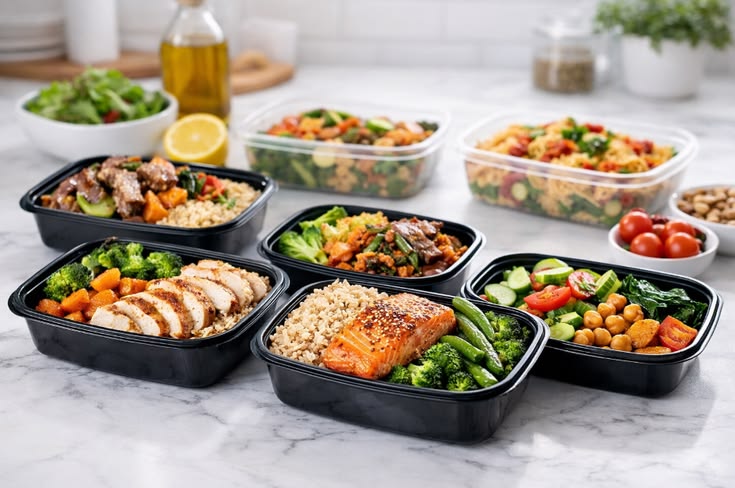
Batching is worth the pan when the second use is not a perfect repeat: different grain, different texture, or a different temperature, so the week still feels like variety. If the second use is a stretch, the batch is too large for the life you are living this week, and that is data for next time, not a character flaw.
Line one: the date. Line two: what is inside in plain language. Line three: reheat or “eat cold for lunch on Wednesday.” The third line is where most homemade plans fail, because the cook still remembers; everyone else is guessing.
From shopping bag to work bag, the route that touches raw protein stays on one side of the routine. A boring rule that prevents a dramatic week.
If you are buying for more than three days, split the list mentally into “this half of the week” and “if we still have energy.” The second list can be a different trip, an online add-on, or a smaller top-up shop. The point is to avoid watching herbs turn while the week already moved.
Some households pick a fixed weekday for a ten-minute “top up” to match how fast they eat fresh produce. That pattern is a habit, not a promise; if your shift pattern changes, the weekday can move, but the top-up should stay on the map somewhere.
If a meeting runs over, the label you left yourself is worth more than the perfect menu. Swap the “portable” and “fallback” ideas without making the night a story about failure. Dense weeks are not exceptional; they are the reason the site exists in the first place.
Each week, look at what you did not touch and ask whether the portion was too big or the day was the wrong one for that style of food. Adjust one input next time.
Keep a short “repeat” list in your own handwriting or file. Long catalogues in apps often become background noise on Thursday night.
If a shared family calendar is already open, a food note in the same place cuts duplicate “what’s for dinner” messages, without inventing a new app habit.
The Simplicity page is the other half of the story: it asks for your energy and attention first, and only then comes back to ingredients. Contact is there if you want to ask about materials, a call, or anything that does not fit a page, always as non-clinical information.
We read with context; we do not offer medical advice in reply.
Open contact